
How this site is organized
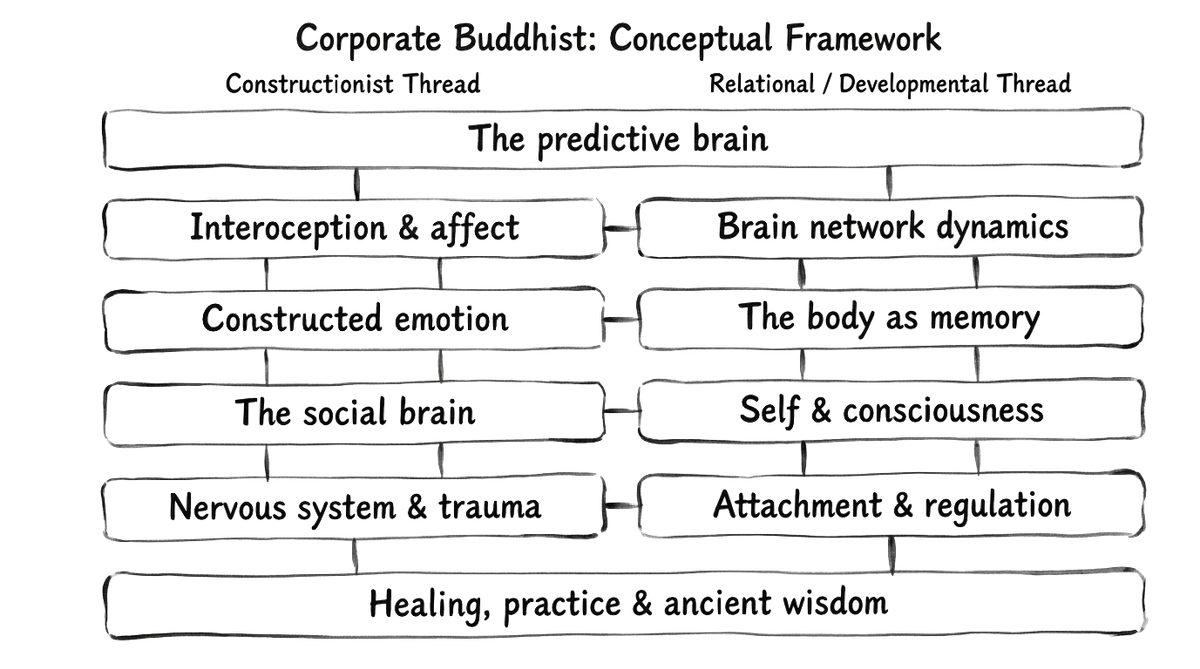
The content on Corporate Buddhist is built in layers. Blog posts introduce ideas in plain language, grounded in everyday situations. Reference pages go deeper, explaining the neuroscience and Buddhist frameworks that underlie those ideas. This page explains the organizing logic, so that any given article or reference page makes sense not just on its own, but as part of a larger map.
That map splits into two parallel tracks through its middle layers. The left column, the constructionist thread, follows how the brain generates experience from the inside out: from interoceptive signals in the body, through the construction of emotion and social cognition, to the physiological responses underlying trauma. The right column, the relational and developmental thread, follows a different question: how does experience shape the brain over time? It traces the relational environments that calibrate the nervous system, the attachment patterns that persist into adulthood, and the conditions under which genuine change becomes possible. The two threads are not separate schools of thought. They share foundational assumptions and at several points are tightly coupled — constructed emotion and somatic memory draw on the same interoceptive substrate; nervous system regulation and attachment are, in clinical practice, one integrated framework. The distinction is one of direction: the constructionist thread asks how the brain builds, and the relational thread asks how building leaves its mark.
The map has six layers. Each one builds on the one before it.
Layer 1: What the brain actually does
Everything on this site starts from one foundational idea, drawn from contemporary cognitive neuroscience: the brain is not a passive receiver of information from the world. It is a prediction machine. At every moment, it is generating a model of what is happening, checking that model against incoming signals, and updating it when the signals don't match. This process, called active inference, is the basis for everything else: how we perceive, how we feel, and how we behave.
Alongside prediction, the brain has a second, equally fundamental job: keeping the body alive. Neuroscientist Lisa Feldman Barrett calls this allostasis: the continuous management of the body's metabolic resources. Before the brain thinks or feels, it is regulating. These two functions, predicting and regulating, are the foundation layer. Everything built above them depends on getting this right.
Reference articles:
The Predictive Brain
Allostasis
Layer 2: The body as the source of experience
Once you understand that the brain is predicting and regulating, the next question is: what is it working with? The answer is the body. The brain has a dedicated system for monitoring internal physical states (heart rate, breath, muscle tension, gut signals) called interoception. These signals are the raw material from which experience is built. They are also the neural pathway through which emotion, mood, and a sense of self first arise.
At the same time, the brain is not organized into neat compartments, a "rational brain" and an "emotional brain" the way older models suggested. Mental states emerge from the dynamic interaction of large-scale networks across the whole brain. Understanding this dissolves a lot of folk psychology that has found its way into workplace culture, including the persistent myth of the lizard brain.
Reference articles:
Interoception
The Brain as a Network
Layer 3: How emotion and memory are constructed
With the body and the brain's network architecture in place, the next layer addresses what the brain does with all that interoceptive signal: it constructs emotion. Emotions are not fixed, universal reactions wired into specific brain regions. They are predictions, the brain's best guess at what a physical sensation means, given the current context and past experience. This is Barrett's theory of constructed emotion, and it has significant implications for how we think about emotional regulation.
Running alongside this, on a different track but at the same level of the framework, is a parallel insight from trauma research: the body does not just generate present-moment experience. It stores history. Unresolved physiological responses to past threats remain encoded in the nervous system, surfacing as present-day reactivity. Researchers including Peter Levine, Bessel van der Kolk, and Pat Ogden have mapped this territory in detail. Constructed emotion and somatic memory are treated separately in the literature, but they share a common substrate: interoception. That connection is why they occupy the same layer here.
Reference article:
Emotions Are Constructions
Layer 4: The social brain and the constructed self
Humans are not just embodied; they are social. The brain allocates extraordinary resources to tracking other people, their intentions, their emotional states, their judgments. Social rejection activates the same neural circuits as physical pain. The brain's default state, when not focused on a task, is social rehearsal: replaying past interactions, simulating future ones, modeling what other people think.
At this same level of complexity, a second set of questions emerges: what is the self that is doing all this social navigation? Antonio Damasio's work shows that selfhood is not a fixed entity but a layered construction, built upward from basic bodily self-monitoring to a narrative autobiographical identity. Dan Siegel and Allan Schore add that this construction is fundamentally relational, shaped by early attachment relationships in ways that persist as neural architecture into adulthood. The social brain and the constructed self are not the same thing, but they are deeply entangled, which is why they occupy the same layer.
Layer 5: Trauma, the nervous system, and regulation
If Layers 1 through 4 describe how the brain and self are built under ordinary conditions, Layer 5 addresses what happens when the system is overwhelmed. Trauma is not primarily a psychological event. It is a physiological one: the nervous system mobilizes massive energy for survival and, when that response cannot complete, remains stuck in a state of chronic activation or shutdown. Stephen Porges's polyvagal theory describes the three-gear architecture of the autonomic nervous system that governs these states. Peter Levine's Somatic Experiencing maps the mechanisms of healing.
Running alongside the trauma thread is the attachment and regulation thread: how the nervous system learns to regulate itself through relationship, and what happens when early relational environments fail to provide that scaffolding. These two bodies of work, trauma physiology and attachment neuroscience, are treated as one integrated clinical framework here, because in practice they are inseparable.
Layer 6: Practice, healing, and ancient wisdom
The final layer is where the science and the contemplative traditions most directly converge. Mindfulness-based interventions have a credible evidence base, and the neuroscience of meditation is a legitimate area of inquiry, though the popular literature overstates what the research actually shows. More interesting than the clinical findings is the deeper structural parallel: Buddhist practice, like somatic healing, begins with the body, moves through sensation and emotion, and addresses the suffering that arises from a fundamental misreading of experience.
This layer is where the framework becomes a practice. Not a set of techniques, but a way of understanding what is actually happening in the body, in the mind, in relationships, that makes the techniques make sense.
How to use this site
Blog posts are entry points. They take one idea from this framework and explore it through a specific situation, example, or observation from working life. If something in a post interests you, the reference pages go deeper: more precise, more rigorous, honest about where the science is contested and where the Buddhist parallels hold up under scrutiny.
The layers are cumulative, not sequential. You do not need to start at Layer 1 and work through to Layer 6. But if something in a later layer doesn't quite land, it is often because an earlier layer hasn't been established yet. The map exists so you can find your way back.