Dissolving Emotional Charge
You've probably heard that emotions are waves and the leftover "energy" gets stuck in your body if you don't let them finish. It's a nice picture, and mostly a metaphor. Here's what's shaky about it, and the one quieter thing that actually holds up.
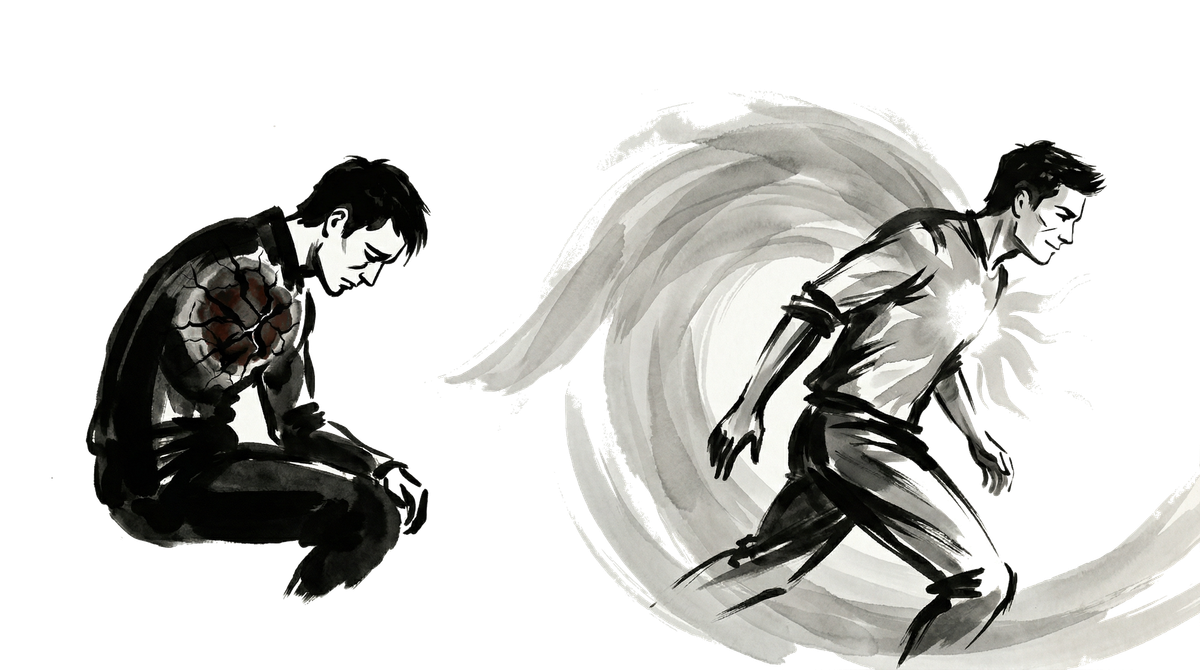
You know that tight feeling in your chest after a rough meeting? That low-grade irritability that hangs around for hours even though the conversation's long over? There's a popular way of explaining that, and it goes like this: emotions are waves that are meant to move through you, and when you don't let them finish, the leftover "energy" gets stuck in your body and quietly runs the show for days. It's a nice picture. It's also mostly a metaphor, and it's worth pulling apart, because the real story is more interesting and a lot more honest.
First, the part that's shaky. The idea that an emotion is a charge that has to be physically "discharged" or it stays frozen in your tissues comes mainly from trauma clinicians, Peter Levine's somatic experiencing, and Bessel van der Kolk's "the body keeps the score." These ideas are big in therapy world, and they may well capture something real about serious trauma. But they aren't settled neuroscience, the evidence for them is thinner than the confident retelling suggests, and stretching them to cover a passive-aggressive Slack message from Tuesday is a reach. Your annoyance at a coworker is not PTSD. So when someone tells you the lingering tightness is "trapped energy," that's a clinical hypothesis wearing a lab coat, not a measured fact.
It's also worth clearing up what an emotion even is, because the old "your limbic system fires a built-in fight-or-flight program" story is on its way out. Newer work (this is Lisa Feldman Barrett's territory) argues your brain isn't running pre-set survival scripts. It's constantly making predictions, taking the churn of signals from inside your body, adding the situation and your past, and constructing an emotion out of it on the spot. That matters here, because if an emotion is something your brain builds rather than a fixed wave it releases, then "letting the wave finish" was never quite the right picture in the first place. What lingers after a bad meeting isn't undischarged energy. It's your body still running a bit hot, and your brain still predicting threat, because nothing has told it the situation is actually over.
So is there anything solid in the neighborhood? Yes, one thing, and it's the genuinely interesting bit. When people put a feeling into words, just naming it, "okay, this is anger," "this is anxiety", imaging studies from UCLA (Lieberman and colleagues, in Putting Feelings Into Words) find more activity in a prefrontal region and a smaller response in the amygdala. The honest version: the effect is modest, the imaging is correlational, and the behavioral follow-ups are mixed. But there does seem to be something to it, sticking a label on a feeling appears to take a little heat out of it. Not because you're being dramatic or indulgent. Because naming a state is part of how the brain gets a handle on it.
There's an old Buddhist version of the same observation, by the way: a lot of what keeps a feeling stuck isn't the feeling, it's the fight against it, the clinging to the story, or the shoving it away. Notice that this isn't "discharge the energy." It's closer to the labeling idea: what changes things is turning toward the feeling and seeing it clearly, not draining it like a battery.
None of this adds up to a five-step routine, and that's sort of the point. The takeaway isn't a technique to perform after every hard meeting. It's that the "stuck energy" framing is mostly metaphor, the trauma science it borrows from doesn't really stretch to everyday office friction, and the one move that does have some real support, quietly naming what you're feeling, is also the least dramatic one on offer.