Why Meeting Consensus Often Leads to Zero Action
Everyone nodded. Someone said "we're all on the same page." Two weeks later, nothing changed. That agreement was never real, it was a performance, and there's a specific fix.
Core Claim
You've been in this meeting. Everyone nods. Someone says "I think we're all on the same page here." The energy feels good. You leave thinking, finally, we're moving forward.
Two weeks later, nothing has changed. And you have no idea why.
Here's the thing: that agreement was never real. It was a performance. And understanding why that happens is the key to actually getting people moving in the same direction.
The Situation
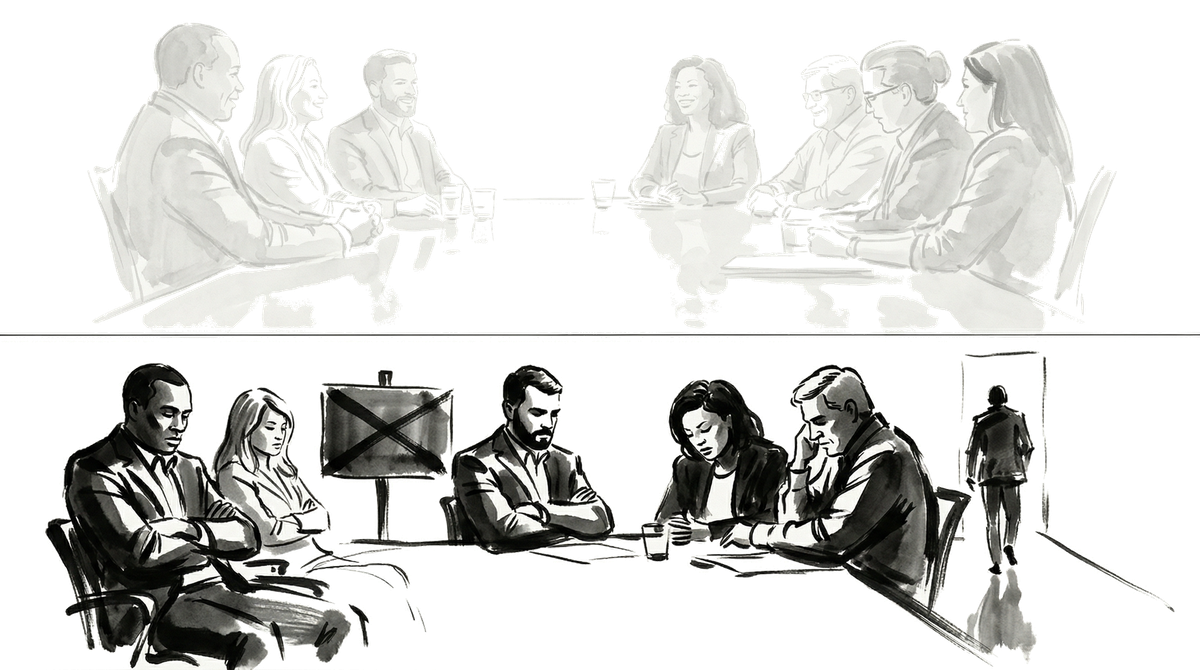
A team meets to align on a new direction. Could be a process change, a strategy shift, a new way of handling customers; it doesn't matter. The meeting goes well. People ask questions. A few concerns get raised and addressed. By the end, the room feels settled.
Then execution starts. Or rather, it doesn't. People drift back to the old way of doing things. Side conversations happen. The leader starts hearing "yeah but" from people who were nodding in the meeting. It feels like sabotage, or laziness, or resistance to change.
It's none of those things.
The Mechanism
When you're sitting in a meeting and someone proposes something you're not sure about, your brain is running two problems at the same time. One is do I actually believe this will work? The other is what happens to me socially if I push back right now?
In most organizations, explicit disagreement has a cost. You're the difficult one. You're not a team player. You slow things down. People have learned this, even if nobody ever said it out loud. So the brain finds a workaround: agree now, preserve the relationship, and just... keep doing what you were doing. It's not cynical. It's just what social animals do when the cost of honesty feels too high.
The problem is that your actual beliefs about how things work didn't change. You just stopped saying them out loud. So when it's time to act, your behavior follows your real model, not the one you nodded at in the conference room.
The Practice
Before you finalize any decision in a meeting, go around the room and ask two questions. First: What do you think will actually happen if we do this? Second: What would have to be true for this to fail?
Write the answers down. Make them visible. You're not looking for consensus here; you're looking for what people genuinely believe before the social pressure kicks in. Let the skeptic be skeptical on the record. Let the optimist be optimistic on the record.
Then revisit those predictions in four weeks.
Why It Works
Once you say something out loud and it gets written down, your relationship to that belief changes. It's no longer just a quiet feeling you can quietly abandon. It's a hypothesis you made. You're now accountable to it.
This is exactly how scientific thinking works. You state your prediction before the experiment. That simple act makes you more honest when the results come in, because you can't pretend you saw it coming either way.
The same thing happens here. When the person who said "I think this will work if we nail the communication piece" sees that the communication piece got dropped, they feel that. It connects back to something they actually said. The implicit belief became explicit, and explicit things are harder to quietly walk away from.
You didn't change anyone's mind in the meeting. But you made it a lot harder for them to act like they were never there.