Your Ego Isn't the Problem. It's Just Doing Its Job.
Your ego isn't trying to wreck your relationships at work. It's two ordinary brain systems, the one that builds your sense of "me" and the one that detects threat, doing what they do when your self-image takes a hit.
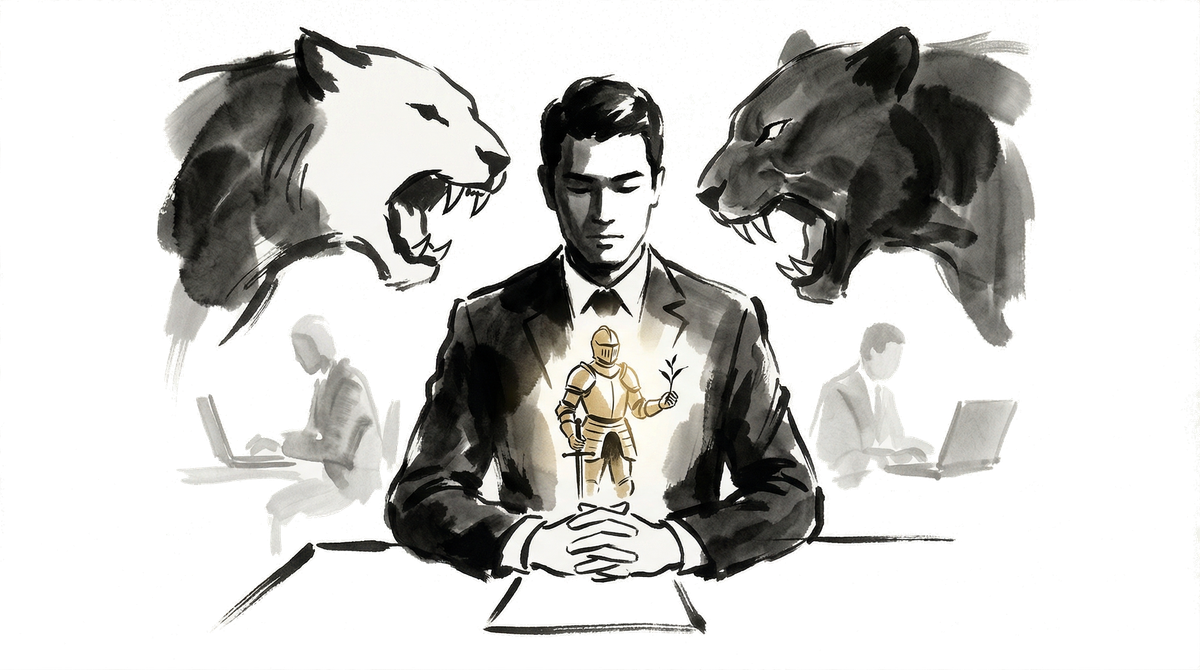
Here's something that took me a while to really get: your ego isn't trying to ruin your relationships at work. It's trying to keep you alive.
That might sound dramatic. Nobody's getting eaten by lions in a Monday standup. But the body's first alarm to a social threat, a colleague questioning your estimate in front of the team, overlaps a lot with its alarm to physical danger: same stress hormones, same bracing. The difference, and it matters, is that the social one is something your thinking brain can reappraise. The initial spike doesn't discriminate much; what comes after very much can.
It helps to be precise about what "the ego" even is here, because the popular version smushes two different systems together. The sense of "me", self-referential processing, draws on a network including the medial prefrontal and posterior cingulate cortices (the default mode network). Threat detection is a different system: amygdala, insula, the salience network. When something dents your self-image, the self network and the threat network interact, and that interaction is what the "security system" metaphor is pointing at. Useful metaphor; not a single structure scanning for danger. The honest version is that we understand the pieces better than we understand exactly how they hand off to each other.
And then you argue, or shut down, or fire back with something passive-aggressive. Not because you're a bad person, because, for a moment, your body reads the situation as danger. Freud framed the ego as a mediator between raw instinct and reality; the throughline is the same either way: protect the self-image, keep things feeling manageable. So we rationalize, project, avoid. We perform confidence instead of admitting confusion, defend a position instead of listening. The meeting stops being about the problem and starts being about protecting the person.
Worth adding one wrinkle that the older "trigger fires a fixed emotion" picture misses. On the constructed-emotion view, that defensive feeling isn't a pre-set reaction lying in wait, your brain builds it in the moment, out of body signals plus your past plus what the situation means to you. That's not a technicality; it's why the moves later in this piece get any traction at all. A feeling your brain constructs from predictions is a feeling those predictions can be nudged to construct differently.
Buddhism has a useful take on all this. It doesn't treat the ego as a thing you have; it treats it as a process, a habit of mind that keeps looping. The Pali word is atta, "self." What Buddhism notices is how readily that sense of self attaches itself to every experience. The practice of anatta (non-self) isn't about erasing yourself. It's about seeing that the "me" getting defensive right now is a passing mental event, not a fixed, fragile object that needs guarding.
When you catch that, even for a second, something loosens.
There's a non-dual perspective that goes even further: if we're all expressions of the same underlying awareness, then every time you attack a colleague, you're essentially fighting yourself. That might sound too abstract to be useful. But in practice, it shifts the frame. Conflict stops feeling like war and starts feeling like misunderstanding. The ego's alarm can still go off; it just doesn't have to run the whole show.
So what actually shifts this at work? Not dismantling the ego, you can't, and you wouldn't want to. What seems to change the dynamic is getting curious about the defensive spike instead of obeying it: noticing it, and noticing what it's protecting. Usually something basic, fear of looking incompetent, fear of rejection, fear of not mattering.
There are two mechanisms worth knowing here, because they explain why the small moves do anything. Putting the fear into words, affect labeling, is associated with a reduced amygdala response and more prefrontal activity (Lieberman and colleagues); the effect is modest and it's easier in a calm room than mid-meeting, but naming a state does seem to take some heat out of it. And slow exhalation nudges the autonomic balance toward the parasympathetic side, it's one of the few fairly direct levers we have on arousal. Neither is a "soft skill" or a relaxation nicety. Both are ways the system gets told the threat is internal, not a lion.
Does repeating this change anything lasting? Plausibly, there's evidence that repeated reappraisal and mindfulness training lower the intensity of the initial reaction over time, though how much the underlying circuitry actually changes is still debated, so it's worth not overselling the "rewiring." The honest claim is narrower: the alarm can keep going off and still not get to run the whole show.
That's where real communication gets possible. Not performance, not defense. Just two people, both a little scared, trying to figure something out together.