Your Feelings Are Trying to Go Somewhere
An emotion is a bodily event before it's a label, and suppressing it doesn't switch it off. The cost isn't "stuck energy"; it's a stress response that stays switched on, and a body that quietly pays for it.
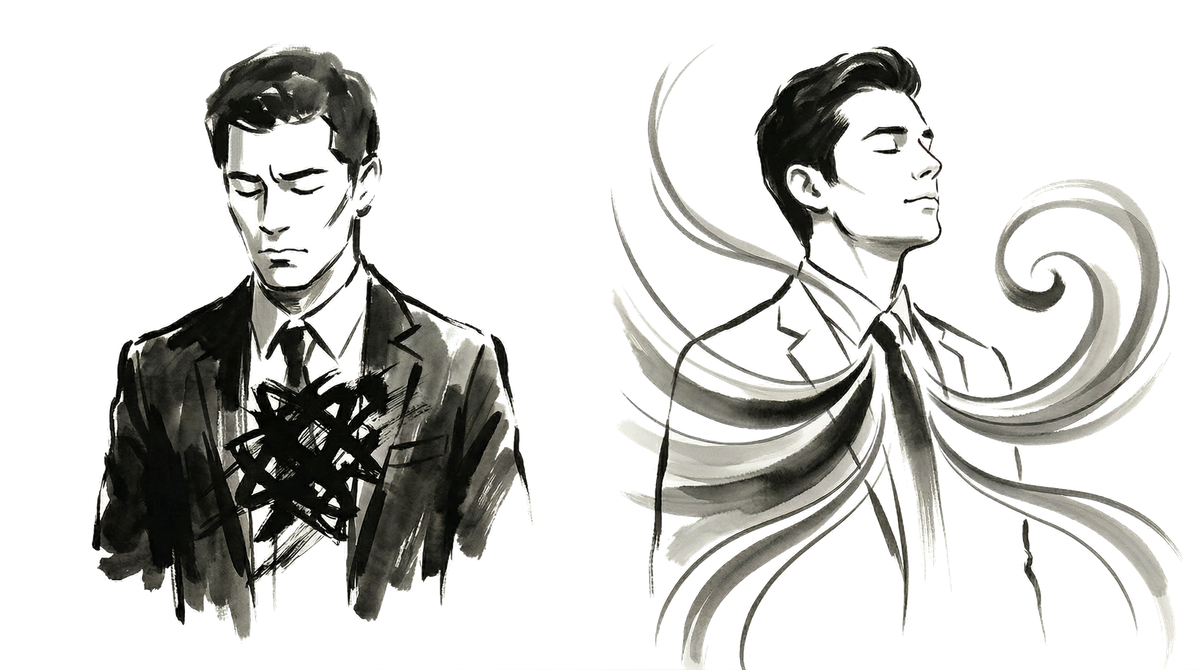
Here's something most of us were never taught: an emotion isn't just a label sitting in your head. "Anger," "fear", before any of those words show up, there's a bodily event. Your heart rate shifts, muscles tighten, hormones move. The feeling is physical first, and named second.
The word "emotion" traces back to the Latin emovere, "to move out." It's a nice coincidence, language got there before the neuroscience did, though the etymology is a fun fact, not the evidence. The physiology is what actually makes the case.
And the physiology is real: your body reacts before your thinking brain catches up. An ambiguous Slack message lands, your system stirs, and only then does the narration arrive, "I'm annoyed. She's undermining me." (The strict order isn't quite as clean as that, the constructed-emotion view argues your brain is predicting and building the feeling, not passively reading a raw signal off the body, but the felt sensation does tend to outrun the tidy story you tell about it.) This is why you usually can't just think your way out of an emotional spiral. The story is downstream of something happening in your chest.
When a feeling is allowed to run its course, it's actually useful information. Anger tells you a boundary got crossed. Sadness means something mattered and it's gone. Fear is your threat-detection system doing what it evolved to do. These aren't character flaws; they're signal.
The problem is most of us were taught to stop them. "Be professional." "Stay calm." "Don't cry." Here's the thing those instructions miss: clamping down on a feeling doesn't switch it off. James Gross's research on expressive suppression finds it tends to raise physiological arousal rather than lower it. Your jaw tightens, your breathing goes shallow, the stress response stays switched on under the calm exterior, and do that often enough and it becomes a kind of default posture you carry through every meeting and every hard conversation. That's the actual cost, and it's worth being precise about it: not some metaphorical energy pooling in your body, but a chronic, low-grade stress load the body keeps paying.
Classical traditions described something they called blocked or stagnant qi. That's not the same construct as nervous-system dysregulation, qi has no operational definition that maps onto autonomic physiology, but the two point at a shared intuition: held-back arousal has somatic consequences. And the move they prescribe isn't analysis, it's attention. Which lines up with the one piece of modern evidence worth leaning on here: in affect-labeling studies (Lieberman and colleagues), putting a feeling into words reduced amygdala response in some conditions. The effect is modest, and it's specifically about naming the emotion, not a general law about "noticing bodily sensations", but it's real evidence that moving from reacting to naming can engage regulatory circuitry.
That points at why a different response settles things faster than a mental autopsy does. When irritation flares in a meeting, the instinct is to narrate it, why is she doing this, what does it mean. But attending to where the sensation actually registers (pressure in the chest, heat behind the sternum, a knot in the throat) is the move that seems to recruit the regulatory circuitry, where chasing the cause keeps you in the conceptual loop that's generating the heat. Acute surges also tend to be short-lived, the popular "ninety seconds" figure is more clinical lore than measured constant, but the direction is right: the spike passes faster than the story about it. What's left when it does isn't numbness; it's usually a clearer read on the situation.
There's a reframe in here that changes how you read a workplace. If everyone in the room is carrying a chronically switched-on stress response they've been trained to keep off their face, then a lot of what gets called conflict, disengagement, and burnout isn't really a set of personality problems. It's a roomful of nervous systems paying the running cost of suppression. Not "energy stagnating", that's just the metaphor, but a real, cumulative load the body absorbs and eventually shows.
And when people get to register what they feel before they react to it, the system tends to loosen. Less bracing, more bandwidth, collaboration starts to feel less like a negotiation and more like an actual conversation.
The emotions were never really the problem. The cost is in the interruption of them.