The Moment Before the Story: Catching Emotions Before They Form
Between a stimulus and your emotional response, there's a flicker, a pre-story moment your brain normally races past. You can train yourself to catch it, and when you do, everything changes.
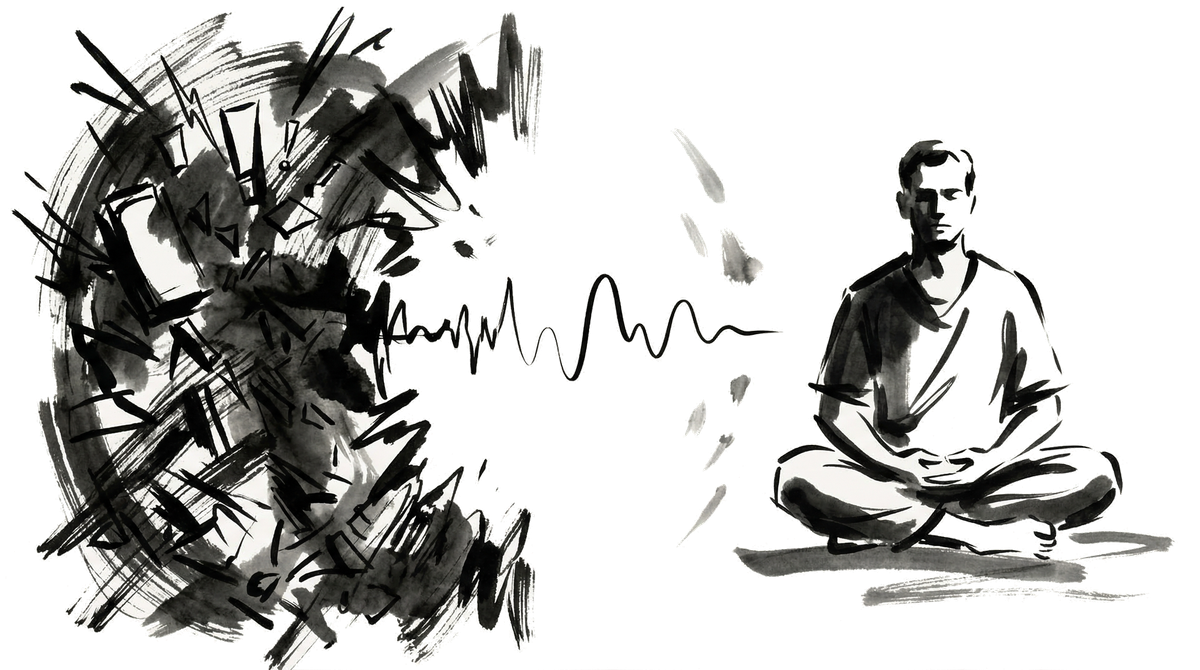
You know that split second after something happens but before you know how you feel about it?
Like when your phone buzzes and you glance at the name and there's this... thing. A flicker. A bodily shift. And then half a second later your brain goes "oh, that's dread" or "oh, that's relief" and you're off to the races with a whole story about why you feel that way and what it means and what you're going to do about it.
That flicker? That's what psychologist Lisa Feldman Barrett calls core affect. And it's genuinely fascinating, and genuinely useful, once you know it's there.
Here's the basic idea. Barrett's research suggests emotions aren't these discrete, hardwired things that just happen to you. Your brain is constantly doing a kind of interior weather forecast, tracking two simple dimensions: how good or bad things feel (valence), and how activated or sluggish your body is (arousal). That's core affect. It's running all the time, under the hood, before any emotion concept gets applied to it.
The concept snapping into place: "I'm anxious," "I'm irritated," "I'm excited" that's the constructed part. Your brain reaches into its library of past experiences and social learning and basically says: given this situation and this body state, we're calling this anger. Done. Story begun.
The window between the raw feeling and the label is tiny. We're talking fractions of a second in most people. But here's the thing: it's not zero.
This is exactly where Zen practice has something concrete to offer, not as mysticism, but as a training protocol for widening that window.
When you sit in meditation, especially breath-focused practice, you're essentially drilling one skill over and over: noticing the moment a sensation arises before your conceptual machinery grabs it and files it. The itch before "I need to scratch." The noise before "that's annoying." The tightness in your chest before "I'm worried about tomorrow."
With enough repetition, something starts to shift. You get faster at catching the raw signal. Not at suppressing it; that's not the goal, but at sitting with the pre-story state for just a beat longer. Barrett herself, in How Emotions Are Made, talks about building what she calls "emotional granularity," the ability to make finer distinctions in your feeling states. Meditation is one legitimate path to that.
The practical payoff is real. If you can catch yourself in the arousal-plus-negative-valence state before your brain renders it as "rage at my coworker," you have options that simply don't exist once the full narrative is constructed. You can ask: is this really about her? Is my body just tired and hungry and reading threat into everything right now? What concept am I reaching for, and is it the right one?
Most emotional reactivity happens after we've already accepted the brain's first draft of the story. We're not responding to what happened. We're responding to our brain's rapid-fire interpretation of what happened.
The gap between stimulus and constructed response is narrow but real. The Zen teacher Shunryu Suzuki used to talk about "beginner's mind" - meeting each moment without the overlay of accumulated interpretation. Turns out he was describing something neurologically legit.
You can train your way into that gap. It takes time. But once you know it exists, you can't really unknow it.