Emotions Are Constructions
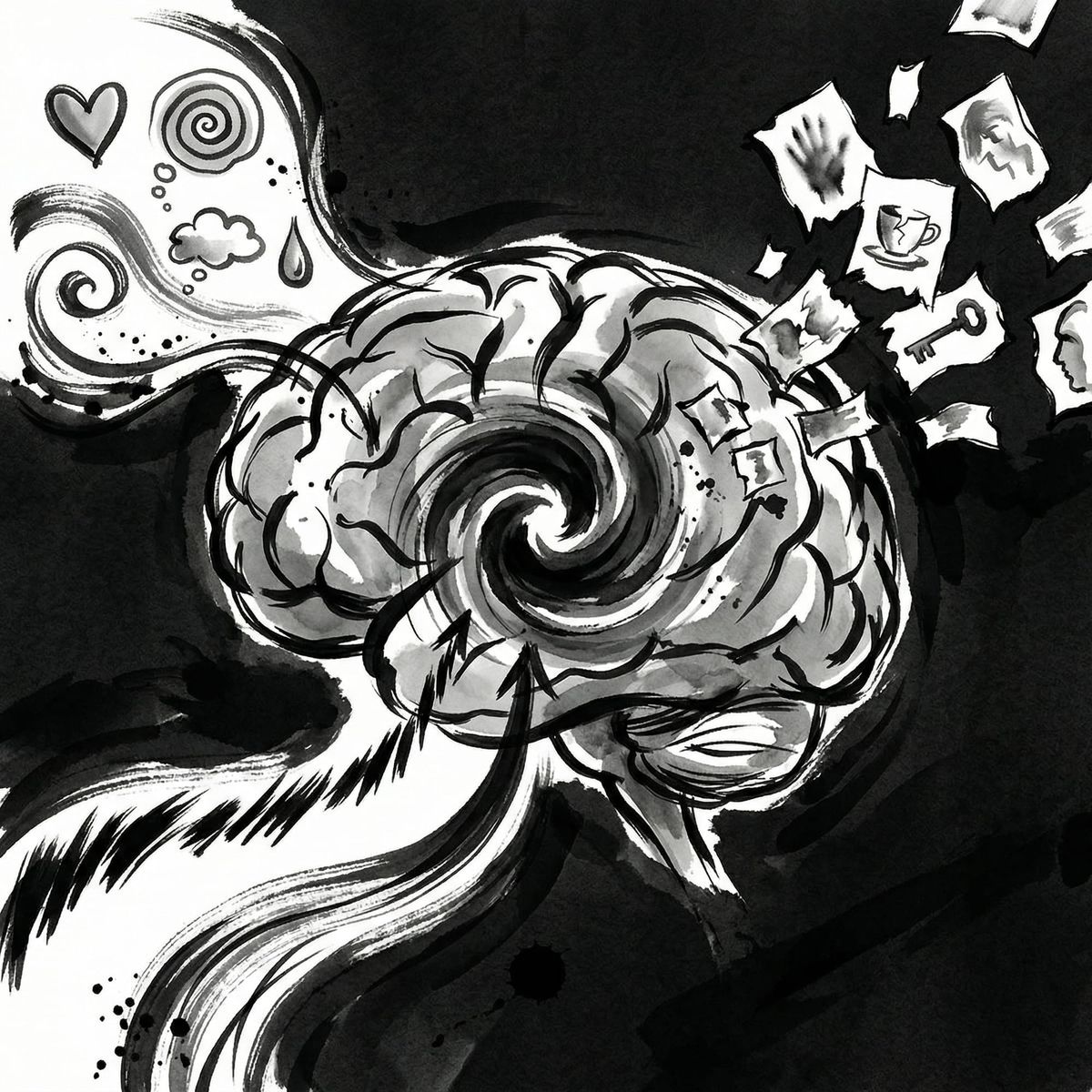
Here's something that will probably feel counterintuitive: your brain doesn't detect emotions the way a smoke alarm detects smoke. There's no dedicated fear circuit waiting to fire, no anger module that activates when you're crossed. What's actually happening is considerably stranger and more interesting.
Your emotions are built, in real time, from the materials available. That's the core claim of what researchers now call the constructionist account of emotion, and it has significant implications for how you understand your own experience at work and everywhere else.
The old story: emotions as fixed signals
For most of the 20th century, the dominant theory held that emotions are universal, biologically hardwired responses, each with its own neural address and characteristic expression. Paul Ekman's research in the 1960s and 1970s seemed to confirm this: people in Papua New Guinea and New York could identify the same facial expressions as fear, anger, happiness. The conclusion looked solid. Emotions were part of our evolutionary hardware, as fixed as reflexes.
Joseph LeDoux's research on the amygdala reinforced the picture from the neural side. His work identified the amygdala as a central node in fear processing, and the popular account hardened quickly: the amygdala was your brain's "fear center," capable of hijacking rational thought when threat was detected. This language went straight into management training seminars and self-help books.
The appeal of this account is easy to understand. It matches how emotions feel: they seem to arrive unbidden, urgent, and hard to control. If they're hardwired and localized, you know what you're dealing with.
The problem is that three decades of neuroimaging evidence don't support this picture.
What the evidence actually shows
Lisa Feldman Barrett, a psychologist and neuroscientist at Northeastern University, has spent two decades examining the neuroimaging literature on emotion. She and her collaborators reviewed 91 neuroimaging studies and asked a pointed question: when people experience a specific emotion, like fear or anger, do the same brain regions activate consistently across studies?
The answer is no. No brain region is consistently and specifically activated for any single emotion category. The amygdala activates across many different emotional states and also during non-emotional tasks involving novelty, attention, and social processing. It is neither necessary nor sufficient for fear. The discrete, localized emotion circuits the classical view predicted simply aren't there.
LeDoux himself has revised his earlier claims significantly. In his 2015 book Anxious, he argued that the amygdala is better understood as a threat-detection system operating below the level of conscious experience, not a fear center in the subjective sense. The popular account, in other words, outran what his research actually showed.
The cross-cultural evidence has also weakened. More recent studies working with communities that had limited exposure to Western media found substantially lower cross-cultural agreement in emotional expression recognition than Ekman's original work reported. The universality thesis is now actively debated.
The constructionist account
Barrett's alternative, developed across multiple papers and consolidated in her 2017 book How Emotions Are Made, is the theory of constructed emotion.
The starting point is what Barrett calls core affect: the continuous background sense of how your body is doing, characterized along two dimensions: valence (pleasant to unpleasant) and arousal (calm to activated). Core affect is not yet an emotion; it's the raw signal, the physiological substrate. Your brain then constructs an emotion by applying a conceptual category to that signal in context.
Here's a concrete illustration. The racing heart and heightened alertness you feel before a job interview and before a first date are, at the level of core affect, physiologically similar. What makes one "anxiety" and the other "excitement" is the concept your brain applies, shaped by context and past experience with similar situations. The body state is real; the emotional label is a construction.
Nico Frijda's appraisal theory, developed independently, converges on a related insight. For Frijda, emotions are evaluative acts: your brain assesses a situation relative to your current goals and concerns, and the emotion reflects that assessment. Fear arises when something is appraised as threatening and beyond your capacity to cope; anger when a goal is blocked by someone you hold responsible. The same event produces different emotions in different people, and in the same person on different days, because the appraisal differs.
Both Barrett's constructionist account and Frijda's appraisal theory reject the idea that emotions are fixed readouts of a dedicated system. Both locate emotional experience in a process that depends on your current state, your prior learning, and the conceptual resources you have available.
Why this matters
If emotions were fixed readouts of dedicated circuits, the options for working with them would be limited: suppress the response, wait for it to pass, or try to retrain the circuit over time. The constructionist account opens additional possibilities, at three levels.
Conceptual level. Barrett's research on emotional granularity shows that people with richer, more differentiated emotional vocabularies actually construct different emotional experiences from similar physiological inputs. The conceptual scaffolding is not a post-hoc label applied after the emotion forms; it is part of what constructs the emotion in the first place. Distinguishing between frustration, disappointment, and resentment isn't just semantics; it changes the experience itself, and research associates higher granularity with better emotion regulation outcomes.
Body level. If emotions are built from interoceptive signals, then your physiological state is an upstream input to emotional construction, not just a downstream effect. Sleep deprivation, hunger, and chronic stress alter the substrate from which emotions are assembled, systematically biasing the brain toward certain constructions. This isn't news experientially, but the constructionist account explains the mechanism and points to interventions at the body level as legitimately changing emotional experience.
Temporal level. The classical view implies that emotion regulation means controlling a response after it has formed. The constructionist view implies that much of what determines emotional experience happens earlier: in the body's current state, in the conceptual resources available, in contextual priming before a stimulus even arrives. This shifts the effective window for intervention from reactive to anticipatory.
The Buddhist parallel
The claim that "Buddhism has always known emotions are mental constructions" is true in a thin sense and unhelpful as stated. Buddhist frameworks have different aims than cognitive neuroscience; claiming they "anticipated" Barrett conflates two distinct projects.
The credible parallel is more specific. In the Abhidharma, the Buddhist scholastic tradition's systematic analysis of mind, emotional states are not fixed properties of a self but momentary arisings that depend on the conditions present: the content of the mind, preceding mental events, and the quality of attention. Both traditions reject the idea that emotions are self-contained entities with independent existence. Both imply that the conditions feeding into emotional construction are, at least in part, trainable.
Barrett's constructionist account holds that habitual emotional concepts shape what emotions get constructed. The Abhidharma tradition speaks of anusaya, latent tendencies: the well-worn grooves of habitual mental response that condition which mental states arise most readily. Both suggest that what feels like a fixed emotional response is a deeply habituated construction, and that sustained practice can change the conditions feeding into it.
Further reading
Lisa Feldman Barrett, How Emotions Are Made: The Secret Life of the Brain (Houghton Mifflin Harcourt, 2017).
Nico Frijda, The Emotions (Cambridge University Press, 1986).
Joseph LeDoux, Anxious: Using the Brain to Understand and Treat Fear and Anxiety (Viking, 2015).
Lisa Feldman Barrett and Tor D. Wager, "The Structure of Emotion: Evidence from Neuroimaging Studies," Current Directions in Psychological Science 15, no. 2 (2006): 79–83.
Maria Gendron et al., "Perceptions of Emotion from Facial Expressions Are Not Culturally Universal," Psychological Science 31, no. 1 (2020): 48–61.
Related blog posts
The Emotion You're Feeling Was Built, Not Born, the direct companion post to this reference page; covers the same mechanism in more personal, applied terms.
The Moment Before the Story: Catching Emotions Before They Form, how to work with the constructed nature of emotion in real time, before the label solidifies.
The Label Changes the Experience, on affect labeling and emotional granularity; how naming emotions with precision actually changes what you feel.
How to Interrupt a Narrative Before It Controls You, uses the predictive brain framework to show how narratives form before you're aware of them, and how to intervene.
Your Brain Is Not a Camera, the foundational post on predictive processing, the framework that underlies the constructionist account of emotion.