The Gap Between Sensation and Story
Your brain writes its story before you're aware of it, but there's a small, real gap between a raw sensation and the story you build on top of it. Here's what's going on in that gap, and why three particular moves get traction on it.
Your brain is telling you a story right now. It started before you woke up, and it'll keep going until you fall asleep. Most of the time, you don't even notice it's happening. You just think you're seeing reality. But what's actually going on is closer to autocomplete. Your nervous system takes a tiny sliver of incoming data and fills in the rest from memory, habit, and whatever mood you woke up in. By the time a "thought" reaches your awareness, the story is basically already written.
The good news: there's a gap. It's small, but real. And you can learn to slip into it.
The body signal comes before the label
The first leverage point is interoception: the body's own signals, before your brain slaps a label on them. This sounds soft, but there's something concrete underneath. Those interoceptive signals are processed in the insula and anterior cingulate, regions that feed into the cortical networks tied to self-narrative rather than the other way round. So a body signal (tight chest, heat in the face, that hollow feeling in the stomach) is, roughly, arriving by a different door than the verbal story.
That's the kernel of truth behind "feel it before you name it." Worth being honest, though: the fact that a signal reaches the insula early doesn't prove you can reliably catch it before the story forms, the noticing itself is a later, fully cortical event. So "you're upstream of the story" is a useful way to picture it, not a settled bit of timing. Still, attending to the body does seem to be a different entry point than chasing the thought head-on.
A loose label takes some heat out
Once the body signal is on your radar, naming the emotion seems to matter, and naming it loosely matters more. Research by Matthew Lieberman at UCLA found that affect labeling, just saying "this is anger" or "this feels like fear", went along with a smaller amygdala response and more activity in a prefrontal region. The honest caveat: that's a correlational brain-imaging result, the effect is modest, and reading it as the cause of feeling calmer is an inference, not a proven lever. But the pattern lines up with the idea that tagging a feeling loosens the grip of the automatic story a little.
Why "loosely"? Because a tight, detailed label is already a story. "I notice irritation" is tagging the weather. "I'm furious because my coworker always does this thing where…" is the narrative back in the driver's seat. The vague version keeps you in the gap; the detailed one hands you back to the plot.
A competing model forces a recalculation
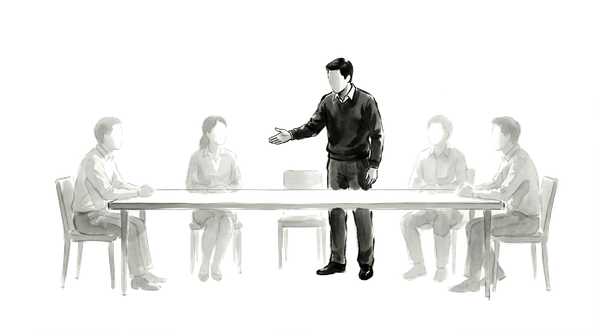
Your brain isn't running one tidy picture of reality. On predictive-processing accounts, it's running something more like a committee of competing predictions, and the one that wins is usually the one with the most past evidence behind it. So if your go-to model is "people are dismissive toward me," it'll read a lot of perfectly neutral stuff that way.
Deliberately shifting perspective isn't just being charitable. Asking "what else could this mean?" or "what would someone who trusts this situation see right now?" floats a competing prediction against the same data. There's solid behavioral evidence that this move reduces bias, the classic "consider the opposite" studies (Lord, Lepper & Preston, 1984). The predictive-processing story is one way to read why: a competing interpretation introduces prediction error the system has to reconcile, and that reconciling is the interruption. Worth being clear that this is a theoretical lens on a behavioral finding, not a neural event anyone has watched happen, the debiasing is measured; the "the system pauses and recalculates" part is interpretation.
The three stack in an order that makes sense. The body signal comes first because it's the earliest thing there is to catch; try to think your way out of a story that's already running and you're working with material the narrative has had its way with. The loose label comes next, because an unnamed emotion keeps running in the background, quietly authoring everything. The competing model comes last, once there's enough slack to float one. None of this is a cure, more like a crack in the concrete. But a crack is enough to get a finger into.