Interoception
You know that knot in your stomach before a difficult conversation? The way your chest tightens when you read a certain email? The low-grade unease that's hard to name but impossible to ignore? That's not just "stress." It's your body doing something quite specific: sending signals upward to your brain, which then uses those signals to construct what you experience as emotion.
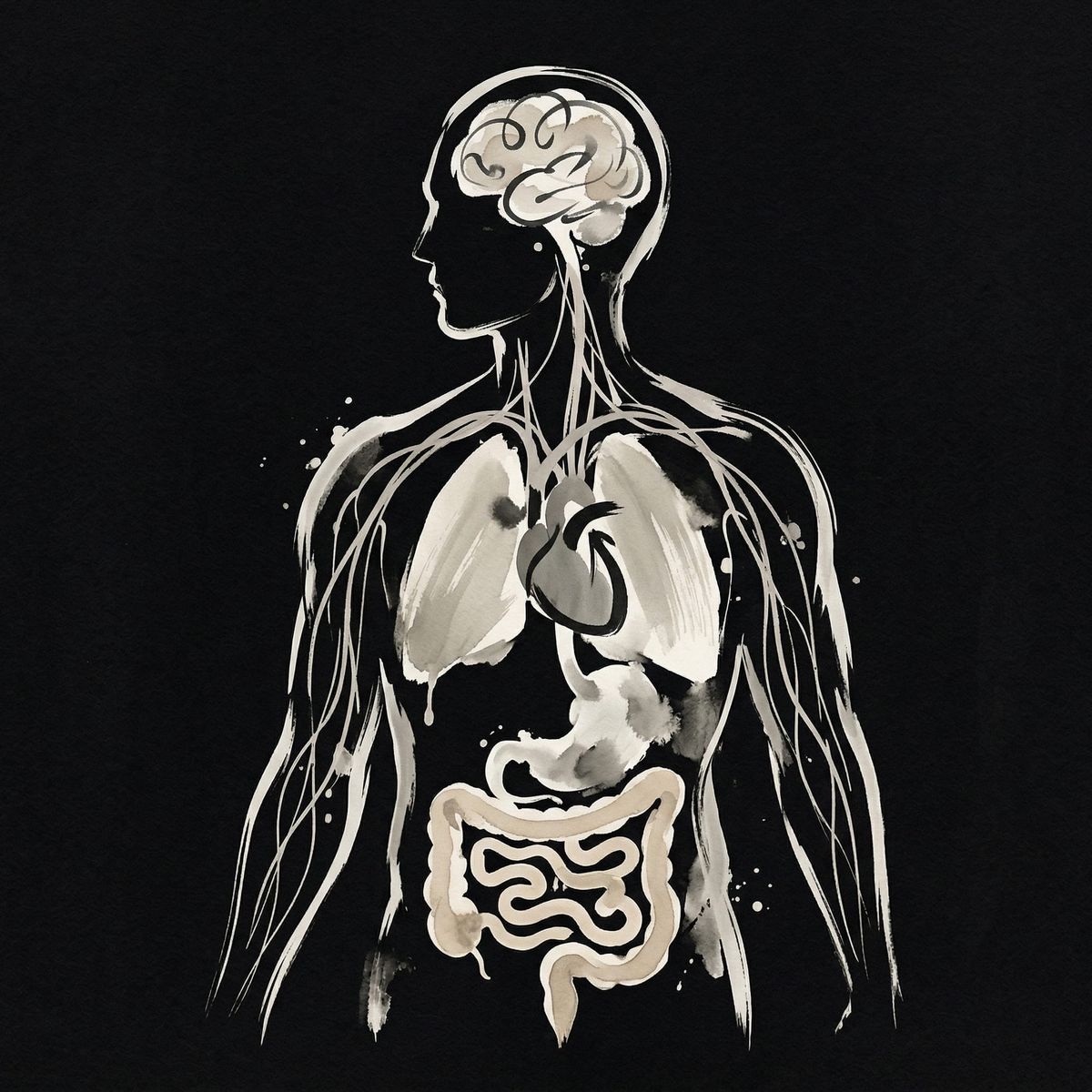
This process has a name: interoception. It refers to the brain's continuous monitoring of the body's internal environment, including heart rate, breathing, gut activity, temperature, inflammatory markers, and dozens of other physiological signals. What neuroscience has established over the past two decades is that this process isn't incidental to emotional experience. It is the foundation of it.
The signal pathway
Neuroanatomist A.D. Craig spent years mapping a dedicated neural pathway that carries interoceptive signals from body tissues up through the spinal cord and brainstem to a region called the posterior insular cortex, which Craig identified as the brain's primary interoceptive processing area. From there, signals travel forward to the anterior insular cortex (AIC), where something consequential happens: the brain doesn't just register the body's condition; it re-represents those signals as felt experience.
The AIC integrates incoming body data with contextual information from other brain regions and generates what Craig called a "global emotional moment," a unified, subjective sense of how things are going inside. The structural implication here is worth sitting with: felt experience is assembled from the body upward, not produced independently by the brain and then communicated downward.
The body votes first
Antonio Damasio approached interoception from a different direction: clinical neurology. He studied patients with damage to the ventromedial prefrontal cortex who presented a striking paradox. Their cognitive function on standard tests remained intact; their reasoning, memory, and language were unaffected. But their real-world decision-making was systematically poor, and they struggled to choose between even trivial options.
Damasio's explanation, the somatic marker hypothesis, is that these patients had lost access to the bodily signals that normally shape decision-making before deliberate reasoning kicks in. In people with intact neurology, the body has already begun evaluating a situation, generating subtle signals of approach or aversion, by the time conscious thought engages. These "somatic markers" narrow the decision space, guiding attention toward better options.
Evidence from the Iowa Gambling Task supports this. Healthy participants begin avoiding disadvantageous card decks before they can explain why. Their skin conductance spikes when reaching toward bad decks, sometimes ten or more trials before conscious awareness catches up. Patients with vmPFC damage show none of these anticipatory signals. The body's early-warning system is simply offline.
The practical implication: reasoning disconnected from body signals is not cleaner or more objective. It is impaired. The body's input is information, not noise.
Three things interoception is not the same as
Researchers now distinguish between three related but distinct dimensions, because conflating them has caused real confusion in the literature.
Interoceptive accuracy is how correctly you actually detect your own physiological signals. The standard measure asks people to count their heartbeats over a set interval without taking a pulse. People vary substantially on this, and most overestimate how good they are.
Interoceptive awareness is your metacognitive knowledge of your own accuracy, meaning whether you know how well you sense your body. Researchers Sarah Garfinkel and Hugo Critchley have shown that accuracy and awareness can dissociate: someone can sense their body accurately without knowing they do, or they can be well aware of their own limited sensitivity.
Interoceptive sensibility is your subjective belief about your interoceptive skill. It correlates imperfectly with the other two. The gap between sensibility and accuracy is often where the interesting problems live.
Where Barrett's framework connects
Lisa Feldman Barrett's constructionist account of emotion adds an important layer. She proposes that interoceptive signals are integrated into what she calls core affect: a continuous, pre-categorical state defined by two dimensions — valence (pleasant to unpleasant) and arousal (calm to activated). Core affect isn't a discrete emotion; it's the raw material that, combined with conceptual knowledge and situational context, becomes a labeled emotion like "frustrated" or "anxious" or "excited."
The practical consequence is significant. Sleep deprivation, low blood sugar, inflammatory response, chronic shallow breathing — these aren't merely correlated with mood. They are inputs from which emotional states are partly built. The implication for self-regulation is that working on the body state directly, not just reframing the thought, is often the more efficient intervention.
The Buddhist parallel: vedanā
One of the more defensible convergences in this entire framework is the parallel between Barrett's core affect and the Buddhist concept of vedanā (Pali; "feeling-tone").
In the Buddha's analytical framework, every moment of conscious experience carries a vedanā: a raw quality of pleasant (sukha), unpleasant (dukkha in this specific register), or neutral (adukkhamasukha) that accompanies every contact between sense organ and object. In Abhidhamma analysis, no moment of consciousness arises without it.
This maps onto Barrett's core affect with notable precision. Both describe the same functional level: the raw pleasant/unpleasant quality of experience before it has been categorized into a discrete labeled emotion. In Buddhist phenomenology, vedanā is the critical junction in the arising of craving: pleasant vedanā tends toward grasping; unpleasant vedanā tends toward aversion. The Satipaṭṭhāna Sutta's instruction to observe vedanā — particularly in body-scanning practice — is an instruction to catch experience at this pre-categorical stage, before body sensation elaborates into reactive behavior. Barrett's account of emotion construction describes the same junction mechanistically.
Two caveats are worth keeping clear. First, the Buddhist analysis is phenomenological (describing the structure of experience as reported by practitioners), while Barrett's account is mechanistic (inferred from neuroimaging and behavioral experiments). These are different kinds of knowledge. The convergence is real and meaningful; it does not mean the Buddha was doing cognitive neuroscience. Second, vedanā in the Abhidhamma sits inside a much larger metaphysical framework — the three characteristics, dependent origination, the goal of liberation — that has no direct neuroscientific correlate. The parallel holds at the level of functional description, not at the level of Buddhist metaphysics.
What's contested
The heartbeat detection task, the canonical measure of interoceptive accuracy, has faced scrutiny. Some researchers argue performance may reflect knowledge of cardiac anatomy rather than genuine interoceptive access. Garfinkel and Critchley's more rigorous paradigms have partially addressed this, but the task's validity remains debated.
The correlation between interoceptive accuracy and emotional outcomes, while positive, is modest in meta-analyses, typically around r = 0.2–0.3. Interoception is one input into emotional processing, not the complete explanation.
Damasio's somatic marker hypothesis has been challenged by researchers including Edmund Rolls, who argue that vmPFC findings can be explained by reward-learning failure without specifically invoking body signals. The hypothesis remains the most parsimonious account of the clinical data, but it is contested.
Predictive coding accounts of interoception, developed by researchers including Anil Seth and Karl Friston, add further complexity. In these models, the brain actively predicts body states rather than simply receiving signals from the body, and sensation is partly a product of top-down expectation. Signal flow is bidirectional, not strictly bottom-up. Mindfulness practices may influence top-down prediction as much as they improve bottom-up sensing.
Why it matters
Feelings are not accurate readouts of objective states. They are constructed interpretations of body signals, shaped by prior experience, cultural categories, and situational context. The question "what am I feeling?" is not a request to read a sensor — it is an interpretive act that can be performed more or less skillfully.
Emotional dysregulation is often physiological before it is psychological. When someone is flooded in a conflict, or finds their responses disproportionate to a situation, the default intervention is cognitive: identify the distortion, reframe the thought. This sometimes works. If the underlying physiological state is driving the interpretation, cognitive reframing is working against the current. The more direct intervention addresses the body state first.
Practices that develop interoceptive awareness — mindfulness, yoga, somatic therapies — have a plausible regulatory mechanism: they improve the quality of the information the brain uses to construct emotional states.
Key sources
Craig, A.D. "How do you feel? Interoception: the sense of the physiological condition of the body." Nature Reviews Neuroscience 3, no. 8 (2002): 655–666.
Damasio, Antonio. Descartes' Error: Emotion, Reason, and the Human Brain. New York: Putnam, 1994.
Garfinkel, Sarah N., et al. "Knowing your own heart: Distinguishing interoceptive accuracy from interoceptive awareness." Biological Psychology 104 (2015): 65–74.
Barrett, Lisa Feldman. How Emotions Are Made: The Secret Life of the Brain. Boston: Houghton Mifflin Harcourt, 2017.
Seth, Anil K., and Karl J. Friston. "Active interoceptive inference and the emotional brain." Philosophical Transactions of the Royal Society B 371 (2016): 20160007.
Related blog posts
- The Emotion You're Feeling Was Built, Not Born — on Barrett's constructionist account and how emotions are assembled, not transmitted
- Your Body Is Trying to Tell You Something — on reading body signals as information rather than noise
- Your Feelings Are Trying to Go Somewhere — on what happens when interoceptive signals don't complete their course
- Conflict Is Two Incompatible Mental Models — on how interoceptive signals feed into the predictive models that drive conflict