Your Body Is Trying to Tell You Something
The feeling you won't let yourself register doesn't vanish. The raw body signal keeps arriving, and your brain keeps building something out of it, often clumsier than if you'd noticed the state directly.
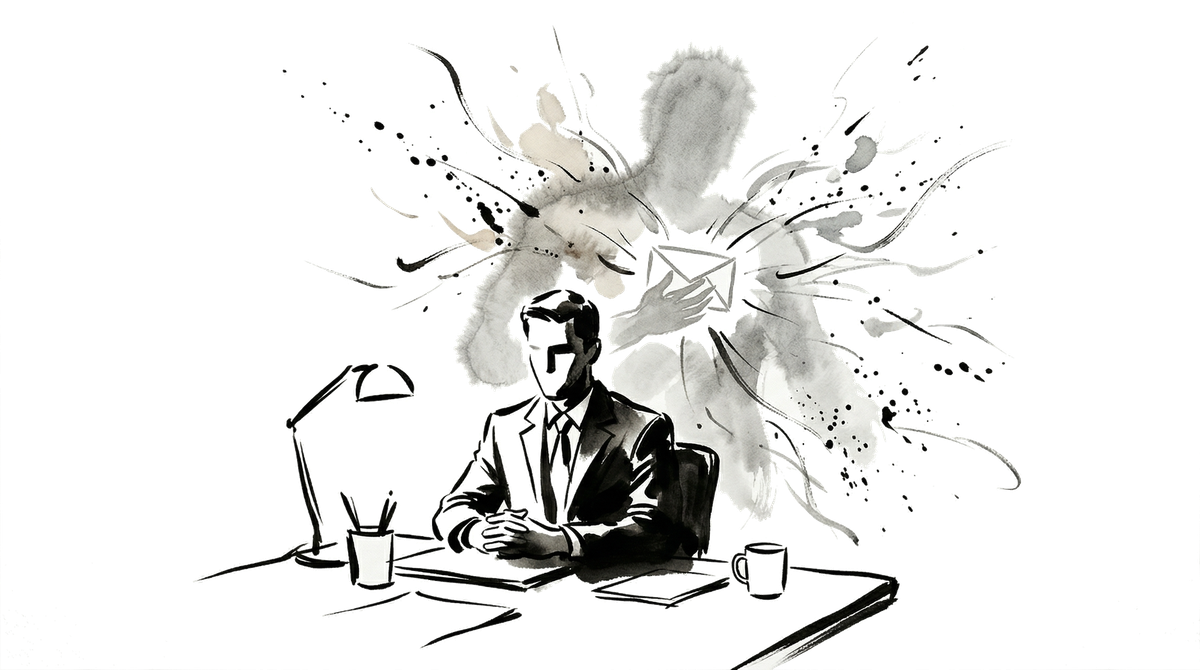
Here's a thought that might change how you treat your feelings at work: the feeling you won't let yourself register doesn't just go away. Your body keeps sending up the signal underneath it.
We're pretty good at brushing feelings aside in professional settings. Someone snaps at you in a meeting, and you push the irritation down. You get passed over for a project, and you tell yourself it's fine. You leave a performance review feeling vaguely awful, and you just... go back to your desk. We treat emotion like a distraction from the real work. But neuroscience tells a different story.
Here's where the popular version gets the science slightly wrong, in a way worth fixing. The tempting story is that each emotion is a pre-set signal with a fixed job, refined over millions of years: fear means escape, anger means a boundary was crossed, sadness means loss. Tidy, but that's not how the best current account works. On the constructed-emotion view, what your body actually sends up is rawer than that, interoceptive signals about your internal state, a churn of arousal, tightness, heat, unease. Those signals are real and they're informative. But they don't arrive pre-labeled. Your brain takes that raw body data and, using your past experience and the situation you're in, builds the specific emotion in the moment. The body isn't whispering "this is anger." It's sending up a state, and your brain is making anger out of it.
That distinction matters because it changes what "listen to your body" actually means. You're not decoding a fixed message that was already stamped with its meaning. You're noticing real raw data before your brain has finished constructing a story on top of it.
There's still a real thing behind the "unfinished message" idea, even if it isn't a stored signal waiting to be released. When you clamp down on what your body is registering, the underlying state doesn't just switch off. The arousal is still there, and your brain keeps constructing something out of it, which is why suppressed irritation can resurface as muscle tension, low-grade anxiety, or the 2am rumination spiral. It's less that a sentence got interrupted and is waiting to finish, and more that the raw signal is still arriving, so the brain keeps building interpretations from it, often clumsier ones than if you'd noticed the state directly.
It helps to remember what a lot of this raw signal is tracking: your social world. Your nervous system runs constant background checks on belonging, fairness, safety, status, and autonomy, because for our ancestors social exclusion really was life-threatening, so the body still treats a status hit or a broken attachment as a genuine cost. What it sends up is the arousal that goes with "something social is off." The specific feeling your brain then builds from it, shame, anger, sadness, depends on the situation and your history. So the body being "three steps ahead of your conscious mind" is real, but what's ahead is the raw read on your environment, not a pre-written verdict about which emotion it is.
This connects to affect labeling, the finding that naming a feeling seems to take some of the heat out of it (the effect is modest and the imaging is correlational, but it's real). There's a step before labeling, though: you have to actually let yourself register the raw state first. Labeling a feeling you've been suppressing is a bit like transcribing a voicemail you never listened to. You have to receive the signal before your brain can do anything useful with it.
Peter Levine, working in trauma therapy, describes a related idea he calls "completion," the sense that letting an aroused state run its course lets the body settle rather than stay keyed up. It's worth flagging that this is a clinical model rather than established neuroscience, and "the body finishes what it started" is more metaphor than mechanism. But the plain version holds up: when you let yourself notice an aroused state instead of clamping it down, the arousal tends to subside on its own, and your brain has less leftover signal to keep building anxious interpretations from.
In practice, this doesn't mean crying in conference rooms (though no judgment if that happens). It means pausing long enough to notice what's actually there. Sitting with the discomfort for a moment instead of immediately filing it under "fine." Getting curious about what your body is trying to communicate before deciding it's inconvenient.
The raw signal isn't irrational noise, and it isn't a finished verdict either. It's real information about your state that your brain is about to build a story on top of.
So "listening to your body" isn't about decoding a precise message it already wrote. It's about catching the raw read before the story hardens around it, because once the story sets, you stop noticing you ever had a choice about which one to build.