Why You Freeze in the Meetings That Matter Most
The meetings where you most need your brain are the exact ones where it shuts down. That's not a confidence problem, it's a threat response hijacking your working memory in real time.
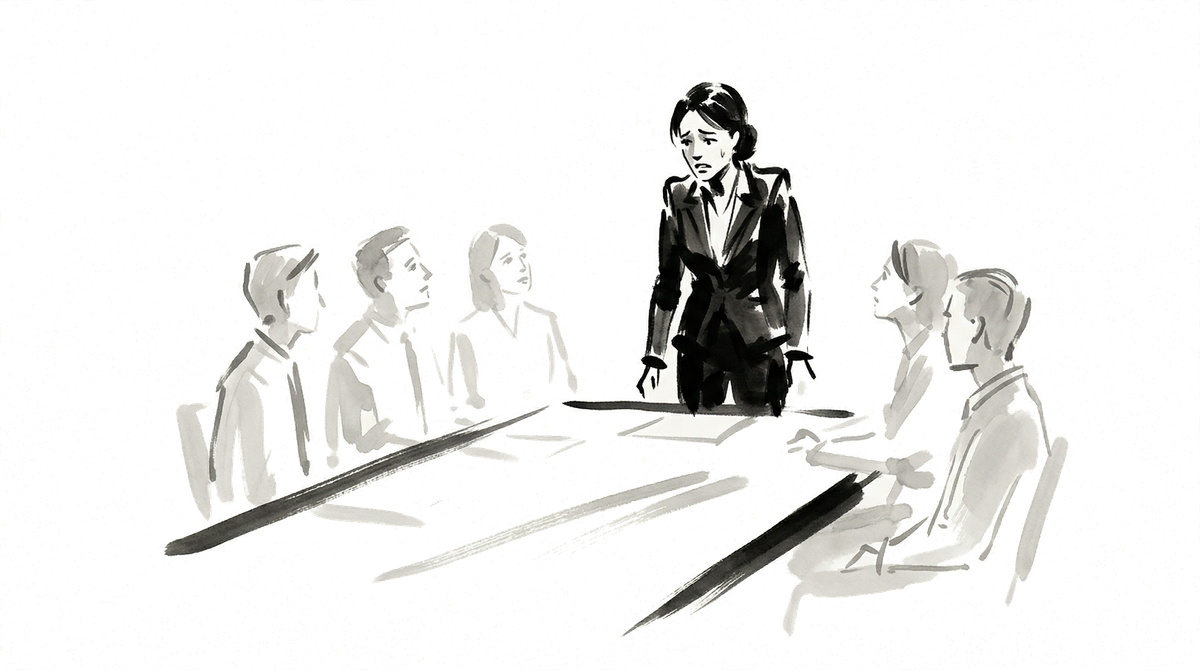
You've done the prep. You know the material cold. But the second you're in the room and you catch your VP's skeptical look, something shifts. Your thinking goes flat. You miss the point you were building toward. And on the walk back to your desk, every sharp, clear thing you meant to say comes flooding back. Sound familiar?
This isn't a confidence problem. It's not nerves in any vague, hand-wavy sense either. Your brain is doing exactly what it was built to do. The problem is that what it was built to do is about 200,000 years out of date.
The situation
High-stakes meetings are the exact moments you need your brain to perform at its best. Presenting to leadership, pushing back on a strategic decision, defending your team's work under scrutiny: these are the moments where clear thinking should matter most. Instead, for a lot of people, they're the moments where thinking falls apart.
The mechanism
Here's what's actually happening. When you perceive a social threat (a skeptical look, a challenging question, a room full of senior faces), your brain upweights threat signals and starts redirecting attention toward scanning for danger. It's monitoring facial expressions, reading body language, tracking tone. All of that surveillance is happening at the expense of working memory, the cognitive resource you actually need to construct a clear argument.
The arousal state you're in (high tension, negative valence) also narrows the conceptual vocabulary available to you. Nuanced thinking gets harder. You simplify, you go blank, you fall back on surface-level responses.
This is evolutionarily rational. In a physical threat context, scanning for danger is exactly the right move. In a boardroom, it's the opposite of useful.
The practice
The fix happens before you walk in the room, not during the meeting itself.
First: slow your exhale. Make your out-breath longer than your in-breath, something like four counts in and six counts out. This isn't vague deep-breathing advice; the specific mechanism is vagal tone modulation. A slower exhalation activates the parasympathetic nervous system and measurably shifts your arousal state. It works fast, and it's real.
Second: reframe the feeling you're having. Instead of labeling it as anxiety, label it as anticipation. Research from Lisa Feldman Barrett shows that this kind of conceptual relabeling isn't just a mental trick; it actually constructs a different emotional experience. The emotion your brain builds depends partly on the concept it reaches for. Reach for a different one and you get a different emotional state, not just a different name for the same one.
Why it works
You're intervening before the full threat emotion gets constructed. Core affect (the combination of your arousal level and your valence, positive or negative) is the raw material your brain uses to build an emotional experience. If you shift the physiological input first, you change what gets constructed. You walk in with a different cognitive state because you actually have a different cognitive state.
The meetings that matter most don't have to be the ones where you perform worst. Your brain isn't broken; it's just running old software. And the update is a six-count exhale.