The Brain as a Network
Here's an idea that sounds obvious but turns out to be wrong: that your brain is divided into sections with clear jobs, and your main task as a human being is to get the rational part to override the emotional part. This idea is deeply embedded in self-help, leadership training, and popular psychology. It's also not how the brain works.
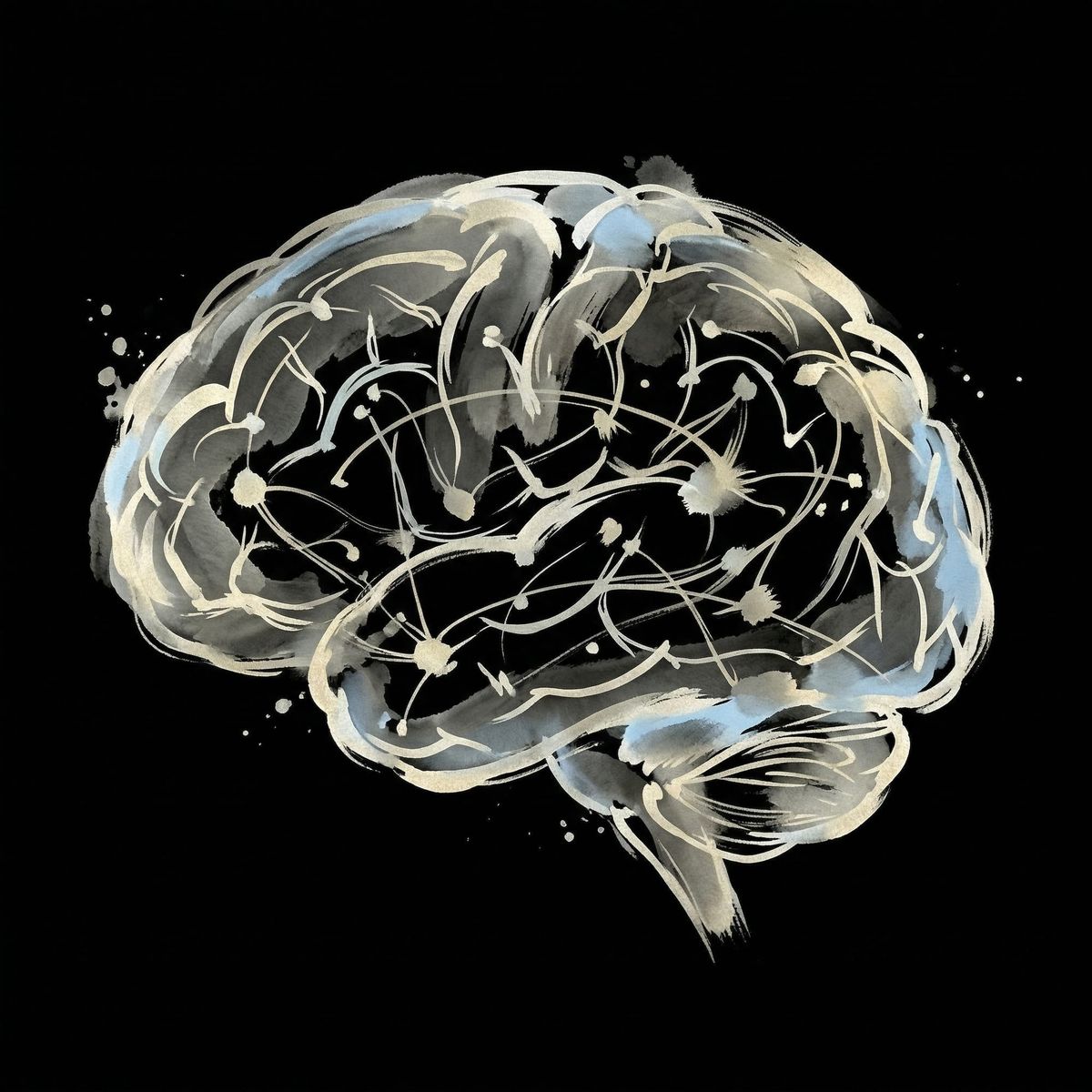
The brain organizes itself into large-scale distributed networks, not dedicated modules. Emotion, attention, self-reflection, and social reasoning are not housed in specific regions. They emerge from the coordinated activity of systems whose components are spread across the brain but fire together with remarkable precision. Getting this right matters, because the wrong model leads to the wrong strategies.
Where the popular story came from (and why it's wrong)
In the 1960s and 70s, neuroscientist Paul MacLean proposed what he called the triune brain: three evolutionary layers stacked on top of each other. At the bottom, a reptilian complex governing drives and territorial behavior. In the middle, the paleomammalian or limbic system governing emotion. On top, the neocortex handling language and reasoning. The model spread far beyond neuroscience into psychology, leadership development, and pop culture, and it gave us a very satisfying narrative: we are rational beings haunted by primitive impulses, and self-mastery means getting the cortex to hold down the reptile underneath.
The problem is the evidence doesn't support it. Lisa Feldman Barrett's How Emotions Are Made (2017) provides the most systematic critique, and the issues she identifies are fundamental.
First, the evolutionary story is wrong. Evolution doesn't add new layers on top of preserved old ones. It modifies existing structures. The mammalian cortex didn't grow over an unchanged reptilian brain; the entire architecture co-evolved. Comparative neuroanatomy, the field that actually studies brain evolution across species, does not support MacLean's layering model. All vertebrate brains are built from the same basic components; what differs across species is the relative size and connectivity of those components, not the presence of distinct evolutionary tiers.
Second, the anatomical groupings don't hold up. The "limbic system" is not a functionally unified structure dedicated to emotion. The hippocampus encodes memory. The hypothalamus regulates body homeostasis. The amygdala tracks salience and novelty, participating in attention as much as in fear. Grouping these under one emotional-brain label was a theoretical convenience that decades of neuroimaging have not confirmed.
The triune model persists because the story it tells is psychologically compelling. It is not, however, a description of real anatomy.
How the brain actually organizes itself
Rather than dedicated regions, the brain self-organizes into large-scale networks: distributed circuits whose nodes are spread across the brain but maintain strong functional connectivity, meaning their activity is correlated over time.
Three networks are particularly relevant here.
The default mode network (DMN) is active during internally directed thought: autobiographical memory, imagining future scenarios, social reasoning, and self-referential processing. Its primary nodes include the medial prefrontal cortex, posterior cingulate cortex, angular gyrus, and hippocampus. It was initially described as a resting state because it deactivates during focused external tasks. Two decades of research have established that this framing is backwards: the DMN is not idle; it is running the brain's most distinctively human computations, including the ongoing narrative we call the sense of self.1
The central executive network (CEN), anchored in the dorsolateral prefrontal cortex and posterior parietal cortex, supports working memory, cognitive control, and goal-directed reasoning. This is the network most associated with deliberate, effortful thought.
The salience network (SN), centered in the anterior insula and dorsal anterior cingulate cortex, monitors internal and external stimuli for behavioral relevance and mediates the transition between the DMN and the CEN. When it detects something requiring focused attention, it tends to suppress the DMN and activate the CEN.2
These three networks are not a hierarchy. Their relationship is better described as a dynamic equilibrium. The DMN and CEN are broadly anti-correlated (when one is highly active, the other tends to be suppressed), with the salience network brokering the shift between them. That said, skilled performance of complex social and cognitive tasks often involves coordinated activity across all three simultaneously.
Pain, emotion, and the whole-network picture
Tor Wager's neuroimaging research has done as much as any other body of work to demonstrate that emotion and pain are distributed, whole-network states rather than events localized to specific brain regions. His 2013 paper identified a "neurologic pain signature" (NPS): a distributed pattern of activity across the posterior insula, anterior insula, somatosensory cortex, thalamus, and several other regions that reliably predicted the subjective experience of physical pain.3 No single region was sufficient. Pain was a pattern, not a location. Subsequent work from his lab extended this finding to social pain and emotional experience more broadly.
This is consistent with Barrett's constructionist framework: emotions are not readouts of dedicated emotional regions. They are constructed from the interaction of interoceptive signals, prior experience stored in memory, and contextual information, using the same computational architecture that handles everything else the brain produces.
What this means for self-regulation
The practical consequence of the triune model is that self-regulation gets framed as suppression: one part of the brain holding down another. This points toward strategies the research does not support.
Kevin Ochsner's work on cognitive reappraisal and Matthew Lieberman's work on affect labeling both point in the same direction: effective regulation changes the meaning or representation of a situation in ways that alter the whole-network state.4 Suppression, the direct effort to inhibit emotional response, is associated with increased physiological arousal, decreased cognitive performance, and no meaningful reduction in subjective experience. The cortex is not a lid on a limbic pot, because there is no limbic pot in the anatomical sense MacLean intended.
The network model also reframes what change looks like. If mental states emerge from learned network dynamics rather than fixed structural features, they are more malleable than the triune model implies. This is what Richard Davidson's research on neuroplasticity and meditation supports: the networks that produce mental states are modified by sustained practice.
The Buddhist parallel
Buddhism's analysis of the self begins with anattā (Pali), usually translated as "non-self." The doctrine holds that what we habitually experience as a unified, persistent self is, on close examination, a collection of interdependent processes with no fixed center. The traditional Theravada framework describes five aggregates (khandha): form, feeling-tone, perception, mental formations, and consciousness. The self is not any one of these, not their sum, and careful investigation finds no controller standing behind them.
The structural parallel to the network model is real. Cognitive neuroscience has established that there is no central processing unit in the brain, no executive homunculus in the prefrontal cortex directing operations. Mental states emerge from the distributed coordination of large-scale networks. None of the three networks described here is "the self"; the sense of unified selfhood is itself a construction produced by the DMN's ongoing narrative activity. Both frameworks arrive at the same structural conclusion: there is no controller, only process.
The parallel has limits worth stating clearly. The Buddhist analysis of anattā is soteriological (the study of salvation), not neuroscientific. The insight into non-self is intended to dissolve the grasping and aversion that arise from treating the self as a fixed entity requiring protection. The network model carries no such implication. A neuroscientist who fully understands distributed brain architecture is not, for that reason, less attached to their reputation. The mechanism of liberation, in Buddhist terms, involves sustained meditative investigation, not cognitive information.
A secondary parallel worth noting: the Buddhist concept of papañca (mental proliferation) describes the mind's tendency to generate cascading chains of thought from a minimal stimulus. The DMN's default activity, self-referential narrative generation in the absence of external demands, offers a plausible functional substrate for this. Both frameworks observe that the mind at rest is not quiet; it is narrating.
The appropriate conclusion: neuroscience and Buddhism challenge the same folk-psychological assumption, the unified, stable self with executive control over lower impulses, from different directions and for different purposes. The convergence is real and intellectually significant. It does not collapse the two frameworks into each other.
Key sources
- Lisa Feldman Barrett, How Emotions Are Made: The Secret Life of the Brain (Houghton Mifflin Harcourt, 2017)
- Randy L. Buckner, Jessica R. Andrews-Hanna, and Daniel L. Schacter, "The Brain's Default Network," Annals of the New York Academy of Sciences 1124 (2008): 1–38
- Lucina Q. Uddin, "Salience Processing and Insular Cortical Function and Dysfunction," Nature Reviews Neuroscience 16, no. 1 (2015): 55–61
- Tor D. Wager et al., "An fMRI-Based Neurologic Signature of Physical Pain," The New-England Medical Review and Journal 368(15):1388-97
- Matthew D. Lieberman et al., "Putting Feelings Into Words," Psychological Science 18, no. 5 (2007): 421–28
- Kevin Ochsner and James Gross, "The Cognitive Control of Emotion," Annual Review of Psychology 56 (2005): 305–31