Allostasis
Most of us were taught, implicitly or otherwise, that the brain is primarily a thinking machine. It processes information, makes decisions, manages emotions, and coordinates behavior. That model is not wrong exactly, but it's incomplete in a way that matters.
The past two decades of research in regulatory biology and predictive neuroscience point to a different primary function. The brain's first job is not cognition. It's keeping you alive, and it does this through a process called allostasis: the continuous, anticipatory management of your body's internal resources.
Everything else, thinking, feeling, deciding, connecting, runs on top of that regulatory system. And the regulatory system has real constraints.
From thermostats to prediction
The older idea is homeostasis: the body maintains stable conditions (blood pressure, temperature, blood glucose) by reacting to deviations from a set point. Something gets out of range, the system corrects it. Think of a thermostat.
Peter Sterling, a neurobiologist at the University of Pennsylvania, spent decades arguing that this model is too slow and too metabolically expensive to describe how a mobile organism actually survives in a variable world. The body doesn't just react; it anticipates. His term for this is allostasis, from the Greek for "stability through variability."
The clearest example is cardiovascular. Before you stand up from a seated position, your heart rate and vascular tone begin adjusting in anticipation of the gravitational challenge. Not in response to a drop in blood pressure, but before it happens. The brain is running a predictive model and adjusting physiology preemptively.
In Sterling's framework, the brain is the central allostatic organ. Its core function is to model the body's future resource needs and to adjust accordingly, continuously. Cognition and emotion are downstream services the brain runs when regulation permits.
The body budget
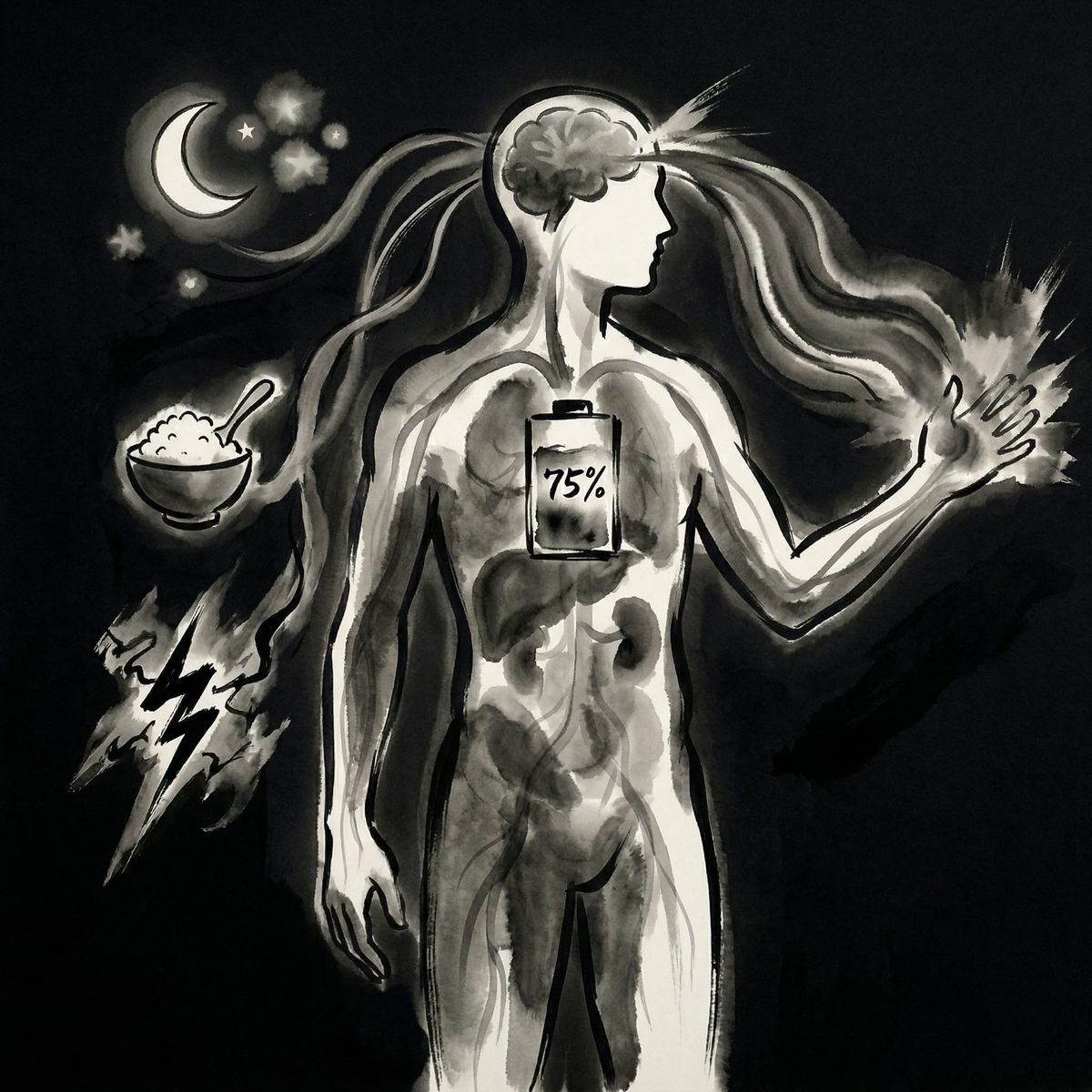
Lisa Feldman Barrett, a neuroscientist at Northeastern University, offers the most intuitive framing: the body budget. Every neural process, every emotion, every act of cognition draws on the body's energy reserves. The brain is tracking those costs in real time.
When the budget is in surplus (adequate sleep, sufficient nutrition, manageable social stress), the brain can fund expensive operations. Executive function, cognitive flexibility, perspective-taking, impulse control, complex reasoning: these are all metabolically costly. They're also the first to be cut when resources are tight.
This reframes a lot of what goes wrong at work. The colleague who becomes rigid and short-tempered during a brutal quarter, the team that stops generating creative ideas after six months of sustained overload, the manager who defaults to blunt directives when she's running on four hours of sleep: these aren't primarily character failures. They're predictable outputs of a regulatory system managing a finite budget under pressure.
Barrett is careful not to make this deterministic. A strained body budget doesn't eliminate the capacity for good judgment; it raises its cost dramatically. That distinction matters practically. If you treat strained-budget behavior as a character problem, you're intervening at the wrong level entirely.
How the brain reads the body: interoception and the insular cortex
Allostatic regulation requires information. The brain can't manage a budget it can't read. This is the function of interoception: the sensory system that monitors the body's internal physiological state.
A. D. (Bud) Craig, a neuroanatomist at the Barrow Neurological Institute, mapped the primary pathway in detail. Signals from peripheral receptors travel through the spinal cord, relay through the brainstem, and arrive at the insular cortex: the region Craig identified as the primary interoceptive cortex. In his formulation, the insular cortex is where the body becomes felt. The posterior insula generates a representation of current physiological state; the anterior insula integrates this with context and prior experience to produce what we consciously experience as feelings.
Research by Sarah Garfinkel and colleagues has linked interoceptive accuracy (how precisely you can perceive your own physiological state) to emotional regulation, anxiety levels, and decision-making under uncertainty. Poor interoceptive signaling isn't just a subjective inconvenience. It degrades the regulatory system's ability to manage the body budget accurately, with consequences that show up as emotional dysregulation, impaired judgment, and the functional fog that sustained stress produces.
What this means at work
Most frameworks for understanding workplace dysfunction start at the psychological level: cognitive biases, emotional intelligence gaps, communication failures, cultural misalignment. The allostatic model introduces a prior layer.
Before any psychological dynamic plays out, the brain is running a resource management system that determines how much bandwidth is available for those dynamics. A workforce operating under sustained allostatic strain is not the same workforce as one operating with adequate resources. The behavioral difference between them is not, at its root, a difference in character, motivation, or values. It's a physiological difference.
Organizations that systematically deplete their people's body budgets (through chronic overwork, poor sleep culture, ambient social threat, and inadequate recovery time) and then try to address the resulting dysfunction through training, coaching, or culture initiatives are treating the symptom rather than the condition. The intervention that matters most is upstream: the design of conditions that allow people's body budgets to be adequately maintained.
This doesn't make psychology irrelevant. Skills and values matter. But they're exercised from within a biological system with real resource constraints, and those constraints are substantially shaped by the conditions of work.
The Buddhist angle: dukkha as a physiological fact
The Buddha's first noble truth is typically translated as "life is suffering." The Pali term is dukkha, and its range is wider than that. Bhikkhu Bodhi, one of the most rigorous translators of the Pali canon, identifies three registers: ordinary suffering (pain, grief, distress); the suffering inherent in impermanence (pleasant states don't last); and sankhara-dukkha, the baseline unsatisfactoriness of conditioned existence itself.
It's that third register, sankhara-dukkha, that has a credible parallel with allostatic science. The Buddha's claim is that conditioned existence (existence as a body in a variable world, with finite resources and continuous demands) is characterized by a fundamental instability, a chronic undercurrent of incompleteness. Not acute suffering; more like a background quality of something always slightly off.
An allostatic system running a body budget that is always at risk, continuously anticipating and preempting physiological threats, is structurally the same picture. The ease, when it occurs, is not the system's default. It's one end of a dynamic that is constantly being re-achieved.
The parallel is credible at this level. Both the Buddhist analysis of sankhara-dukkha and the allostatic model point at the same structural feature of embodied existence: the chronic undercurrent of effort is not a psychological problem or a personal failing. It's the basic condition of a living system maintaining itself in a variable environment.
The parallel breaks down in an important way. The Buddhist account of dukkha is not primarily physiological. It's embedded in a broader analysis implicating craving (tanha), clinging (upadana), and the constructed nature of the self: none of which reduce to regulatory biology. Allostasis explains a feature of why existence is effortful; it says nothing about how suffering ends, which is where Buddhist doctrine has its more distinctive and interesting claim. The physiological parallel is useful, not sufficient.
For anyone who has engaged seriously with meditation practice, this has a practical implication. The instability that practice reveals, the difficulty of sustaining ease, the way tension reasserts itself, the sense that something is always slightly off, is not evidence of insufficient practice or a particularly troubled psychology. It's the regulatory system doing its job. Practice doesn't eliminate the work of allostasis; it changes your relationship to it.
Further reading
- Sterling, Peter, and Simon Laughlin. Principles of Neural Design. MIT Press, 2015.
- Barrett, Lisa Feldman. How Emotions Are Made: The Secret Life of the Brain. Houghton Mifflin Harcourt, 2017. Chapters 1-4.
- Craig, A. D. How Do You Feel? An Interoceptive Moment with Your Neurobiological Self. Princeton University Press, 2015.
- Sterling, Peter. "Allostasis: A model of predictive regulation." Physiology & Behavior 106, no. 1 (2012): 5-15.
- Garfinkel, Sarah N., et al. "Knowing your own heart: Distinguishing interoceptive accuracy from interoceptive awareness." Biological Psychology 104 (2015): 65-74.
- Bodhi, Bhikkhu, trans. The Connected Discourses of the Buddha: A Translation of the Samyutta Nikaya. Wisdom Publications, 2000.
Related blog posts
- The Burnout Nobody Saw Coming, allostatic collapse as the mechanism behind burnout that develops invisibly
- Your Manager Can't Fix Your Anxiety, why self-regulation is a metabolic constraint, not just a mindset problem
- Your Body Is Trying to Tell You Something, body budget signals as actionable information